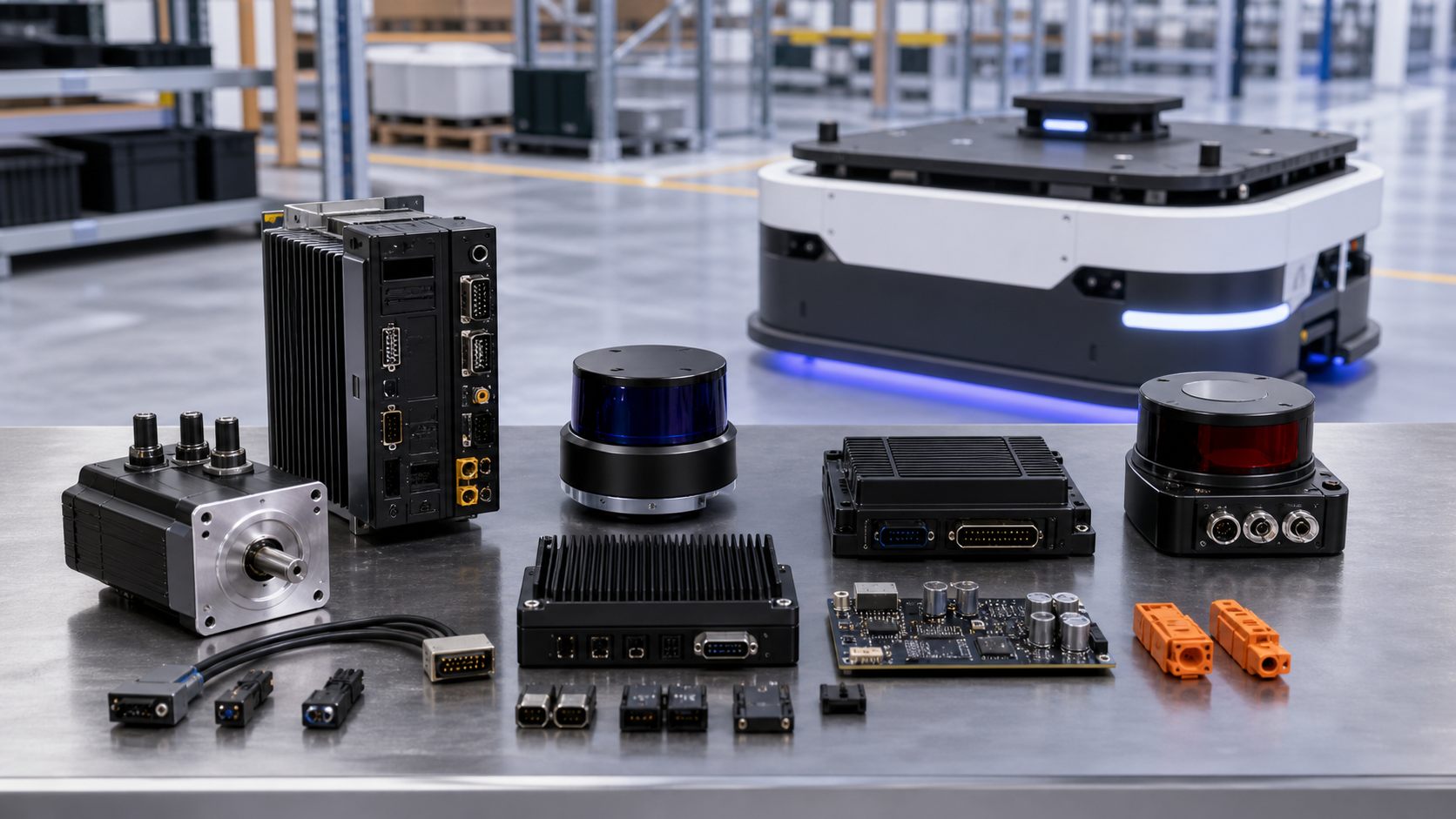
Autonomous Mobile Robots are increasingly powering modern warehouse and manufacturing environments. Their uptime, precision, and safety depend on the electronic components inside the platform. A strong AMR bill of materials should balance availability, integration fit, industrial durability, and documentation.
Use this guide as a sourcing checklist when comparing AMR components, qualifying suppliers, or building a multi-line BOM for production and field service.
1. Servo Motors and Drives
Servo motors are the muscle of an AMR. Look for high-torque, low-inertia brushless DC servos with integrated encoder feedback. Useful specs include torque range, voltage input, IP rating, thermal limits, brake options, and protocol support such as CANopen or EtherCAT.
2. LiDAR Sensors
LiDAR is a primary navigation sensor for obstacle detection, mapping, and localization. 2D LiDAR is sufficient for many structured warehouse routes, while 3D LiDAR supports more complex environments. For sourcing, confirm scan range, angular resolution, refresh rate, shock resistance, and ROS or fleet software compatibility.
3. Battery Management Systems
The BMS monitors and protects the lithium battery pack. Critical features include cell balancing, over-current protection, temperature monitoring, state-of-charge reporting, and CAN or RS485 communication. Poor BMS selection is a common cause of short battery life and unplanned downtime.
4. Motor Controllers and ESCs
The motor controller bridges the main compute system and the drive motors. Field-oriented control can deliver smooth torque at low speeds, which matters for docking, pallet positioning, and narrow-aisle navigation. Regenerative braking support can also improve energy efficiency.
5. Depth Cameras and Vision Modules
Depth cameras add 3D perception for pallet detection, load verification, and human-aware navigation. Check interface type, frame rate, operating temperature, mounting requirements, and whether the camera is supported by the robot's perception stack.
6. Industrial Single Board Computers
The compute module is the brain of the AMR. AI-heavy robots may need GPU-accelerated embedded computers, while cost-sensitive platforms may use lower-power industrial SBCs. Prioritize fanless design, eMMC or industrial SSD storage, wide voltage input, and long lifecycle availability.
7. IMU Sensors
Inertial Measurement Units provide acceleration and angular velocity data for dead reckoning when LiDAR or camera references temporarily degrade. For AMR use, compare drift, sampling rate, vibration tolerance, calibration support, and mechanical mounting options.
8. Industrial-Grade Connectors
M8 and M12 circular connectors, XT-style power connectors, and high-current modular connectors are common AMR staples. Vibration resistance, current rating, ingress protection, and strain relief matter because connector failures are frequent field-service issues.
9. Safety Laser Scanners
Safety scanners are different from navigation LiDAR. They define protective and warning zones and interface with safety controllers or drive systems. Confirm OSSD outputs, safety rating, zone configuration tools, and compatibility with applicable AMR or AGV safety standards.
10. Wireless Communication Modules
Wi-Fi 6, industrial 5G, or private-network modules connect the AMR to fleet management systems. Roaming handoff latency, antenna placement, cybersecurity support, and industrial temperature range should be reviewed before production sourcing.
How SparxPro Helps AMR Teams Source Faster
SparxPro supports AMR and AGV builders with multi-line BOM quoting across servo motors, LiDAR, BMS modules, controllers, connectors, scanners, and commissioning spares. Send a component list or rough BOM and our team will map availability, documentation, and alternates for your build.